Pesticide Exposure Linked to Parkinson’s Disease Risk, Review Finds
08/22/2026 / By Ramon Tomey

A body of epidemiological research links pesticide exposure to Parkinson’s disease. Research at the University of California San Francisco (UCSF) finds that pesticide exposure increases the risk of developing Parkinson’s disease, regardless of whether disease onset is idiopathic or genetic [1].
Although the exact cause remains unknown, epidemiological and toxicological research repeatedly identifies exposure to pesticides, as well as specific gene-pesticide interactions, as significant risk factors [2]. The findings nevertheless add to a broader pattern. About a third of the world’s population suffers from some nervous system disease, and growing evidence suggests that exposure to pesticides in all forms contributes to the disorders, according to Children’s Health Defense [3].
Global Burden and Rising Prevalence
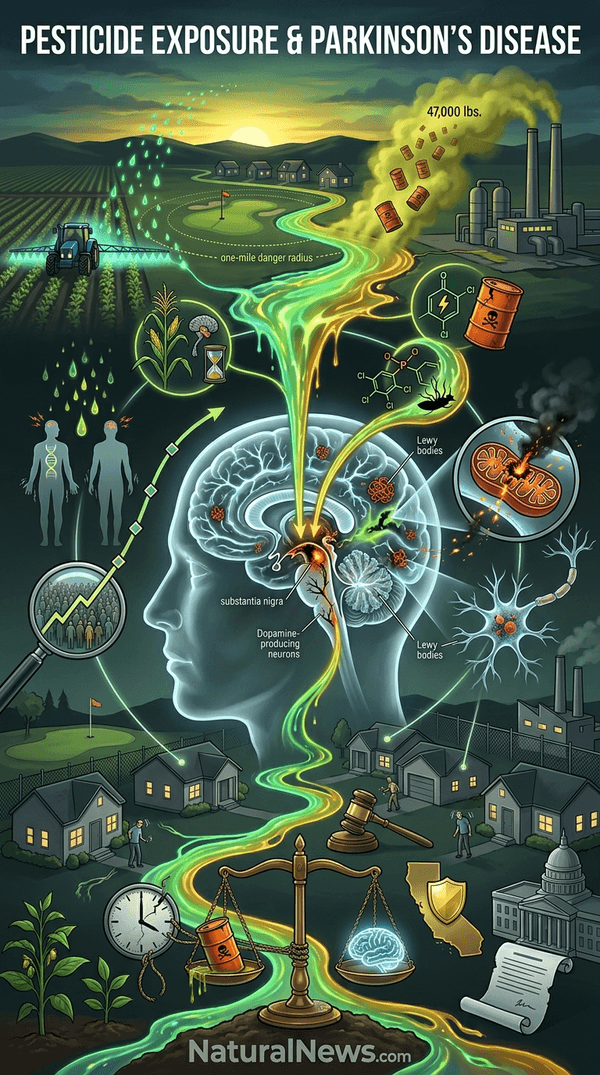
Parkinson’s disease is a chronic condition involving degeneration of dopamine-producing brain cells in the substantia nigra, according to Joseph Keon’s book “Whitewash” [4]. The disease is marked by effects on memory and thought, hand tremors, loss of facial expression and an uncoordinated gait. Pathologically, Lewy bodies are considered the hallmark of classic Parkinson’s disease, according to the “Textbook of Natural Medicine” [5].
A cohort study of more than 140,000 people published in Annals of Neurology found that people who reported exposure to pesticides or herbicides before 1982 had a 70% higher incidence of Parkinson’s disease 10 to 20 years later than those not exposed. Meanwhile, a second analysis linked pesticide exposure to a relative risk of 1.8 (95% CI, 1.4-2.4) [6].
Pesticides Identified and Associated Risks
Vermont in May 2026 became the first U.S. state to ban paraquat, a herbicide the Michael J. Fox Foundation described as highly toxic [7][8]. “Decades of scientific research show that people who apply paraquat are more than twice as likely to develop Parkinson’s disease compared to those who use other pesticides,” the foundation stated [8].
Mechanistic studies have tied pesticide exposure to cellular damage. Most Parkinson’s disease-related pesticides cause mitochondrial complex I dysfunction and oxidative stress, according to a paper in the Journal of Neuroscience [9]. A 2025 study reported that atrazine, a widely used herbicide, may accelerate brain cell aging and increase the risk of Alzheimer’s and Parkinson’s by damaging neurons and prematurely aging stem cells in the hypothalamus [10].
Residential proximity to treated areas has also been examined. Residents living within a mile of golf courses face a 126% higher risk of Parkinson’s disease due to pesticide exposure compared with those living six miles away, according to a March 2026 report [11]. A related account found golf courses in Florida had pesticide risk scores hundreds of times higher than those in Denmark [12].
Chlorpyrifos and Paraquat Investigations
Long-term residential exposure to chlorpyrifos is associated with a more than 2.5-fold increase in Parkinson’s disease risk, according to a study published May 15, 2026, in Molecular Neurodegeneration by researchers at UCLA Health [13]. The study compared approximately 830 individuals with Parkinson’s disease with roughly 830 controls and used California pesticide use reports to estimate residential exposure over time [13].
According to a June 2026 report, Wayne County in Mississippi recorded a Parkinson’s mortality rate of 21.5 per 100,000 residents between 2018 and 2024 compared with the national average of 11.5 – placing the county in the top 7% of all U.S. counties [14]. The Sipcam Agro plant in Wayne County processed and released 47,000 pounds (lbs) of paraquat in 2024 and a combined 81,667 lbs in 2023 and 2024, the report stated [14].
California has begun a formal phase-out of paraquat after manufacturers voluntarily canceled their registrations for products containing the chemical, according to the California Department of Pesticide Regulation [15].
Preventability and Regulatory Context
The Environmental Protection Agency (EPA) has moved to withdraw its interim regulatory decision on paraquat, announcing it needs more time to examine the health effects of the weedkiller [16]. In August 2021, the EPA revoked all tolerances for chlorpyrifos, effectively banning its use on food. In November 2023, the U.S. Court of Appeals for the Eighth Circuit overturned the ban, allowing its use on food crops unless states rule otherwise [17].
Some public health advocates say the policy response has lagged. Eliminating these chemicals could go further in protecting public health than simply treating symptoms once a disease takes hold, according to Children’s Health Defense [3]. The available research identifies specific gene-pesticide interactions as significant risk factors [2] and pesticide exposure as a risk factor regardless of genetic status [1].
Conclusion
Taken together, the cited studies and regulatory actions describe a disease influenced by pesticide exposure and genetic status. Researchers at UCSF found pesticide exposure increases risk regardless of genetic status [1]. A 2006 Annals of Neurology cohort found elevated incidence decades after reported exposure [6].
State and federal decisions remain in flux. Vermont has banned paraquat [7], California has begun phasing it out [15] and the EPA has reopened its review [16].
References
- Children’s Health Defense. “Pesticide Exposure Increases Risk of Developing Parkinson’s Disease”. ChildrensHealthDefense.org.
- Children’s Health Defense. “Pesticide Exposure Increases Risk of Developing Parkinson’s Disease”. ChildrensHealthDefense.org. November 6, 2020.
- Children’s Health Defense. “Research Increasingly Links Pesticides to Neurological Disorders”. ChildrensHealthDefense.org.
- Joseph Keon. “Whitewash”.
- Dr Michael T Murray. “Textbook of Natural Medicine Fifth Edition”.
- “Pesticide Exposure and Risk for Parkinson’s Disease”. Ann Neurol. 2006.
- “Vermont Becomes First U.S. State to Ban Paraquat, Neurotoxic Herbicide Linked to Parkinson’s”. NaturalNews.com. May 29, 2026.
- “Republican Governor Signs Bipartisan Legislation To Enact Nation’s First Statewide Ban Of Controversial Herbicide”. 100percentfedup.com. June 5, 2026.
- “Apoptosis-Inducing Factor Deficiency Sensitizes Dopaminergic Neurons to Parkinsonian Neurotoxins”. Journal of Neuroscience.
- Ava Grace. “Study finds commonly used herbicide atrazine accelerates the aging of brain cells”. NaturalNews.com. January 14, 2025.
- Patrick Lewis. “Groundwater contamination near golf courses linked to increased Parkinson’s risk”. NaturalNews.com. March 17, 2026.
- Children’s Health Defense. “Living Near a Golf Course Dramatically Raises Risk of Parkinson’s”. ChildrensHealthDefense.org.
- “Chlorpyrifos Exposure Associated With 2.5-Fold Increase in Parkinson’s Risk, Study Finds”. NaturalNews.com. May 17, 2026.
- “Paraquat Emissions Linked to Elevated Parkinson’s Rates in Mississippi County, Report Finds”. NaturalNews.com. June 18, 2026.
- “California phases out paraquat, pesticide linked to Parkinson’s Disease, amid growing legal and scientific pressure”. NaturalNews.com. August 14, 2026.
- Children’s Health Defense. “EPA Delays Decision on Popular Weedkiller Linked to Parkinson’s”. ChildrensHealthDefense.org.
- Stacy Malkan. “EPA Admits Chlorpyrifos Damages Kids’ Brains, But Efforts to Ban the Insecticide Fall Short”. ChildrensHealthDefense.org.
Explainer Infographic
Submit a correction >>
Tagged Under:
big government, brain, brain damaged, brain function, Censored Science, chemicals, chlorpyrifos, Dangerous, dementia, Environmental Protection Agency, EPA Watch, paraquat, Parkinson's Disease, pesticide exposure, poison, research, toxic chemicals, toxins
This article may contain statements that reflect the opinion of the author
RECENT NEWS & ARTICLES